The magnificent resurgence of Catholic pilgrimages – and what it means for the Church
By James Bascom
June 9, 2026
For the past five years the Western world has been overwhelmed with tragedy. The Covid lockdown, the war in Ukraine, political polarisation, and a general social disintegration have produced a deep malaise and fear about the future.
And yet, in the midst of this disorder an extraordinary trend has emerged: the sharp increase in adult converts to the Catholic Faith around the world. In France, adult and adolescent baptisms rose from an average of 5,000 per year before 2020 to 21,386 at Easter 2026, the highest recorded since the French Bishops Conference began publishing data in 2002. Similar increases have been seen in the United States, the United Kingdom, and many other countries.
These astounding numbers, to be sure, are still dwarfed by the general trend of de-Christianization. From 1960 to 2023, the percentage of French adults who identify as Catholic fell from 95% to just 25%, while those with “no religion” grew to be an outright majority at 53%.
Nevertheless, the rise in converts is one of the most important religious phenomena of modern times. By all accounts it is a clear grace of the Holy Spirit, and a sign of a deep discontent in public opinion with the modern world. Msgr. Olivier de Germay, archbishop of Lyon and the church official responsible for the catechumenate in the country, wrote that “although it has long been apparent that our consumer society struggles—if not outright fails—to meet the deepest longings of human beings, we are nonetheless surprised by the suddenness and the extent of the thirst for God that is being expressed today.”
Pilgrimages are back
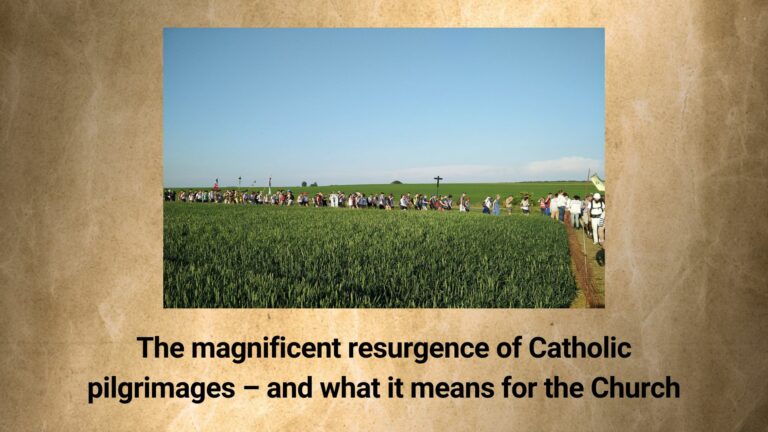
This “thirst for God” has not only brought about more baptisms. Pilgrimages and processions across Europe and America are seeing the greatest resurgence in living memory. In most Catholic countries right up to 1960s, street processions in honour of the Sacred Heart, Our Lady, Corpus Christi, or a local saint were an almost weekly occurrence. Sadly, by the beginning of the twenty-first century many have shrunk or even died out completely. But over the past few years there has been a noticeable increase in interest especially among young people, families, recent converts, and Catholics devoted to the Traditional Latin Mass.
In France many bishops and priests have stated that there has been a steady increase of interest in traditional street processions. French historian Philippe Martin has remarked that after a long period of decline Catholic processions are coming back due to a “desire—coming more from the grassroots than from the church hierarchy—to return to these traditional forms in order to affirm one’s faith and make it visible.”
Major European shrines are seeing an increase in pilgrims. Fatima received 6.5 million visitors in the jubilee year of 2025, an all-time record and surpassing the pre-pandemic high of 6.3 million in 2019. That same year, approximately 3-4 million visitors travelled to Lourdes, more than recovering from the Covid slump. The “Camino” pilgrimage to Santiago de Compostela is experiencing one of the greatest surges in popularity in its history. The number of pilgrims completing the Camino has risen from approximately 5,000 in 1990 to 530,000 in 2025, and all-time record high. Many clergy report a growing attraction among Catholics, especially youth and converts, for the austerity and asceticism of walking pilgrimages in our consumerist, hyper-connected world.
American Catholics have also seen a significant interest in pilgrimages and processions. In 2024 more than 250,000 people participated in the National Eucharistic Pilgrimage. Four different routes converged at the Eucharistic Congress that year in Indianapolis, Indiana, the first such Congress in the United States since 1941. Its success inspired the National Eucharistic Pilgrimage of 2026, which includes tens of thousands of Catholics accompanying processions of the Blessed Sacrament in major cities on the East Coast.
The only approved Marian Apparition shrine in the United States, Our Lady of Champion, saw 200,000 pilgrims visit in 2024, a record high. The shrine’s annual 22-mile Walk to Mary pilgrimage began in 2013 with just a few hundred pilgrims, but reached approximately 10,000 this year, also a record.
But it’s not just the great pilgrimage sites. Smaller, local pilgrimages and processions in honour of local saints have seen significant growth or renewed interest, especially among young people and families. The annual procession from the Cathedral of Tours to the Basilica of Saint Martin, which takes place on the evening before his feast day of November 11, has grown from just a handful to several thousand people each year. Others such as the Grand Pardon pilgrimage to Sainte-Anne d’Auray in Brittany, the “Petit Tour” in Normandy, and “Notre-Dame-du-Très-Haut” in the French Alps have also grown.
But the pilgrimage that most symbolizes this Catholic renaissance is the Paris-Chartres pilgrimage. Founded in 1983 to promote the Traditional Latin Mass, the 100 km (62 mile) pilgrimage over Pentecost weekend grew from a few thousand pilgrims in the 1980s to 10,000 in 2007, 16,000 in 2023, 19,000 in 2025, and more than 20,000 in 2026 (with thousands more turned away due to logistics constraints). The average age is 24, reflecting the overwhelming presence of teenagers, families, and young adults.
The Paris-Chartres pilgrimage has inspired a number of similar pilgrimages across Europe and the world. In 2021, Spanish Traditionalist Catholics inaugurated a 60-mile pilgrimage from Oviedo to the shrine of Covadonga, where the Spanish Reconquest began. From just a handful the first year, participation grew to 1,700 in 2025. In England, the annual 57-mile pilgrimage to the Shrine of Our Lady of Walsingham organized by the Latin Mass Society was launched in 2011 and has grown to more than 500 participants.
What does this mean for the Catholic Church?
This rebirth of Catholic pilgrimages is not a quaint return of dusty traditions, nor a reenactment of old-school religion for a generation seeking novelty. Rather, it’s a sign of a profound grace and spiritual renewal inside the Catholic Church with far-reaching consequences.
First, it is a proof that God continues to intervene in history, especially at this moment of extreme crisis. At a moment of near universal immorality and apostasy, when the world has never been so sinful, the temptation for those few who remain faithful is to despair. God has not abandoned the world but rather remains a loving Father who is continuously sending graces of conversion and repentance. This fact should give Catholics hope, especially in the days to come.
Second, it is a sign of a growing rejection of a certain progressivist spirituality that has dominated inside the Catholic Church since the 1960s. According to this view, the modern world is a friend to be embraced with a spirit of optimism rather than an enemy to be confronted and resisted. There is no need to proclaim the Faith in the public square, or to fight back against a hostile world. “After the Council,” explained French priest Fr. Gérard Boisgontier, 66, “we tended – myself included! – to want to purge the faith of its overly popular elements.”
The sudden reversal of this trend is a rebuke to this progressivist tendency. Unlike the 1960s, practicing Catholics in the twenty-first century increasingly see themselves as a persecuted minority. The secular state continues to impose laws at odds with Catholic morals, such as LGBT “rights”, Gender Ideology, abortion, and assisted suicide. Cultural institutions blaspheme Catholic beliefs, such as the 2024 Paris Olympics Opening Ceremony. And both the state and the culture support the Islamization of Europe and the West.
With so many threats to the Faith and to Christian civilization, it’s no surprise that a more militant, orthodox, Catholicism as seen in traditional pilgrimages and processions is attracting converts, especially among the young. Progressive Catholic movements, while still powerful, are more noteworthy for their dwindling numbers and greying hairs. As the crises in the Church and society worsen, it is all but certain that this great turning towards tradition will continue to grow.