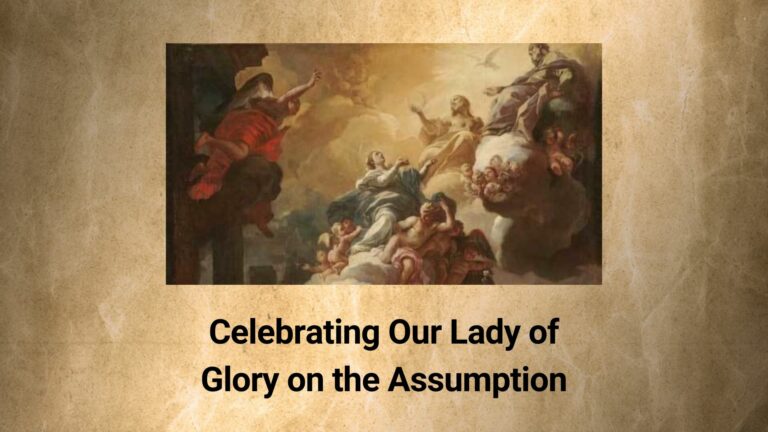
Celebrating Our Lady of Glory on the Assumption
By Plinio Corrêa de Oliveira
In ancient times, people referred to the Feast of the Assumption of Our Lady as the Feast of Our Lady of Glory. They understood that the Assumption was not merely the physical event of Our Lady leaving this earth and being taken to Heaven; it was also her glorification.
After her humble and largely unknown life on earth, Our Lady assumed an even greater role following the death of Our Lord, as Queen and Mother of the Catholic Church. She endured all kinds of suffering, anguish, and humiliation during her earthly life. It was therefore fitting that Our Lord should glorify her in the eyes of men through her Assumption.
She was glorified with the unique privilege of being taken bodily into Heaven by the angels. From there, she was received into the heights of heavenly Paradise, where she enjoys the beatific vision of God in an ineffable way.
Many traditions and revelations concerning the Assumption affirm that this glorification was accompanied by indescribable manifestations of heavenly splendour. Our Lady was a human creature whose nature, considered in itself, was inferior to the angelic nature. To appreciate the difference, we need only recall accounts of saints who, upon seeing their guardian angels, were so dazzled by their splendour that they thought they were seeing God. Yet guardian angels are among the lower ranks of the angelic hierarchy.
We can therefore only imagine the glory of Our Lady as she was taken to Heaven amid the highest Cherubim and Seraphim. She was honoured by God’s highest creatures with such profound respect and veneration that even they might have considered themselves unworthy to offer her their homage.
The Glory of the Assumption
After bidding farewell to those on earth, we can picture Our Lady rising from the ground in a most holy ecstasy as the manifestations of the angels began. If all nature rejoiced on Easter Sunday, and if all creation was jubilant on the day of the Ascension, we can imagine the magnificent joy of nature at the Assumption of Our Lady.
We can imagine the splendid colours of the sky and how brilliantly the stars must have shone. If the sun danced and changed colours at Fatima, we can imagine how wonderfully it might have appeared on that day. The angels must have sung in magnificent harmony, while those witnessing the event experienced profound and ineffable interior consolation.
The essential point is that, during the Assumption, Our Lady’s inner glory was manifested outwardly. She possessed a most holy soul and an inexpressible dignity and majesty, and at that moment her grandeur shone forth in an extraordinary way. Just as Our Lord’s majesty was manifested in His glorified body on Mount Tabor, so Our Lady’s sanctity might naturally have shone through her eyes, countenance, and entire person.
We can imagine this manifestation as a tremendous flash of light filling the heavens. Yet amid such grandeur, she must also have displayed immense maternal tenderness, for she was a mother bidding farewell to her children. She must have shown an extraordinary outpouring of mercy and supreme goodness, making it clear that although she would no longer be physically present on earth, a new phase of her great mission from the heights of Heaven was beginning.
A Mission That Continues from Heaven
Saint Thérèse of the Child Jesus said that she wished to spend her Heaven doing good on earth. If this could be said of the Little Flower, how much more could it be said of Our Lady!
From the time of the Assumption onward, Our Lady’s glory has been increasingly manifested. We see evidence of this in the enormous number of churches dedicated to her throughout the world. As Saint Louis de Montfort observed, it is difficult to find a Catholic church without at least one altar dedicated to Our Lady.
Her maternal intercession continues throughout the life of the Church. Her glory is therefore not something confined to the moment of the Assumption. Rather, it continues to unfold throughout history as generations of Catholics honour her, seek her intercession, and recognise her role as their heavenly Mother.
Our Lady's Supreme Glorification
Our Lady’s glory will continue to increase until the end of the ages, when the Last Judgment arrives. On that day, the truth about every human life will be made manifest. For Our Lady, who is faultless and without guilt, Judgment Day will therefore be a day of supreme glorification.
If the virtues and defects of all creatures are to be made known at the Judgment, what canticles of praise will be offered to her by Our Lord Jesus Christ, the Holy Ghost, and the Eternal Father? Such a scene is beyond our ability to describe.
At the conclusion of human history—when earthly life has reached its end and the final historical event has taken place—Our Lady will receive a glorification that is truly unfathomable. The Feast of the Assumption therefore invites us not only to contemplate the moment when she was taken into Heaven, but also to contemplate her enduring and ever-increasing glory as Queen and Mother.
Adapted from an informal lecture given by Professor Plinio Corrêa de Oliveira on August 13, 1965. The original text was translated and adapted for publication without his revision.