A Young Man and His Lady Love: St. Thomas Becket’s Devotion to Mary
In twelfth-century England, a group of young men had gathered together and were doing what young men have done throughout the ages: boasting. Their lively conversation moved from archery to sword fighting and horsemanship, each trying to surpass the accomplishments of the others. Eventually, their boasting turned to foolish love affairs.
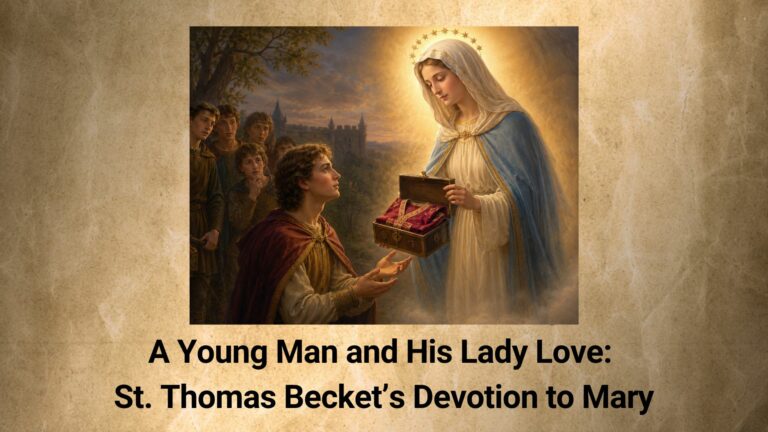
Not wishing to be outdone, a noble young man named Thomas declared that he, too, loved a great lady—and that this lady loved him in return. But Thomas’s “Lady Love” was not the woman his companions imagined. He was speaking of the Blessed Virgin Mary. The young man was Thomas of Canterbury, whom the Church would come to know as St. Thomas Becket.
St. Thomas Becket and His Love for the Virgin Mary
After making his boast, Thomas began to regret it. He loved Our Lady deeply and feared that speaking of his devotion in this playful way might somehow have offended her.
According to the beautiful tradition recounted by St. Alphonsus Maria de Liguori in The Glories of Mary, the Blessed Virgin saw Thomas’s distress and appeared to reassure him. She told him that he had been right to say both that he loved her and that he was loved by her. As a pledge of that love, she gave him a remarkable gift.
It was a small box containing a blood-red chasuble. The gift pointed towards what awaited Thomas: the grace of becoming both a priest and a martyr. And so it came to pass. Thomas became a priest and later Bishop of Canterbury.
Our Lady Does Not Forget Her Children
The story of Thomas and his “Lady Love” did not end with his youth. Years later, after suffering persecution from the king, Thomas fled England and went to a Cistercian monastery at Pontignac in France. He was far from his homeland, his family and everything familiar.
But he was not far from his Lady.
During his exile, Thomas was attempting to repair the haircloth shirt he customarily wore after it had been torn. He was having difficulty mending it properly. According to the account preserved by St. Alphonsus, the Blessed Virgin once again appeared to him.
With extraordinary maternal kindness, Our Lady took the garment from Thomas and repaired it for him herself.
It is a wonderfully intimate episode. The Queen of Heaven, whom Thomas had loved as a young man, was presented not only in majesty but also performing a simple act of kindness for her devoted servant.
From a Young Man's Boast to a Martyr's Crown
Thomas eventually returned to Canterbury. The playful young nobleman who had once boasted to his friends about his mysterious Lady Love had travelled a long spiritual road. He became a priest. He became a bishop. He suffered for the Church.
At the age of fifty, according to the account, he gave his life as a martyr because of his zeal for the Church. Seen in the light of his martyrdom, the blood-red chasuble of his youth takes on its full significance. What began almost as a youthful boast had revealed something much deeper: Thomas belonged to Our Lady, and she was leading him towards Christ.
What St. Thomas Becket Teaches Us About Marian Devotion
There is something particularly beautiful about the way this story presents devotion to the Blessed Virgin Mary.
Thomas does not regard Our Lady as a distant idea. He loves her personally. He calls her his Lady, trusts in her affection and fears offending her. And Mary, in turn, is presented as a mother who does not forget those who love her.
She accompanies Thomas from youth to maturity, from England to exile, and along the path that would eventually end in martyrdom.
True devotion to Mary always leads us towards her Son. In Thomas’s story, love for the Blessed Virgin was not an escape from sacrifice. It accompanied him towards greater fidelity to Christ and His Church.
Perhaps that is the most beautiful meaning hidden in the young man’s boast. Thomas really did have a great Lady whom he loved. And he really was loved by her.
Our Lady, Queen of Martyrs, pray for us.
St. Thomas Becket, pray for us.
This story is adapted from an account in The Glories of Mary by St. Alphonsus Maria de Liguori. https://en.wikipedia.org/wiki/The_Glories_of_Mary