
Is Vulgarity the Language of the Devil?
“What is man that thou are mindful of him, or the Son of Man that thou visit him? Thou has made him a little less than the angels, thou has crowned him with glory and honour.” (Psalm 8:5–6)
Psalm 8 reminds us of the extraordinary dignity God has given to man. If we have been made “a little less than the angels,” our conduct—including our speech—should reflect that dignity.
Yet vulgar language has become increasingly accepted in everyday life. Words once avoided in polite company are now heard almost everywhere, often without regard for the presence of children, families, priests or religious.
For Christians, this raises a deeper question: what does our manner of speaking reveal about the state of our souls?
What Does the Bible Say About Foul Language?
Sacred Scripture does not treat speech as morally insignificant.
Saint Paul commands: “Put them all away: anger, wrath, malice, slander and foul talk from your mouth” (Colossians 3:8).
Speech has a noble purpose. Through words we communicate truth, goodness and beauty to others. Good speech can instruct, encourage, console and elevate. Vulgar speech can do the opposite: it can degrade what should be treated with dignity and encourage anger, impurity or contempt.
This is especially serious when vulgarity becomes blasphemy—the irreverent use of God’s holy name.
Why Has Vulgar Language Become So Common?
One reason is the disappearance of many of the social restraints that once discouraged vulgar speech. Children were taught that certain words simply should not be used. Adults generally exercised greater restraint according to the people and circumstances around them. Public vulgarity attracted disapproval rather than applause.
Today, foul language can instead be presented as amusing, rebellious, authentic or even necessary to make an argument seem forceful. But Christians should ask whether fitting in with such a culture is compatible with our calling to virtue.
Self-restraint matters. If we continually surrender to anger, laziness or uncontrolled passions in other areas of life, our speech can eventually reflect the same lack of discipline.
Is Vulgarity the Language of the Devil?
The most disturbing forms of vulgarity are traditionally associated with demonic manifestations, where obscenity and blasphemy frequently accompany hatred of sacred things. In this sense, vulgarity and blasphemy might indeed be described as the language of demons.
That does not mean that every person who utters a vulgar word is deliberately serving evil. It does mean that Christians should consider what kind of spirit their words express. Are our words ordered toward God, truth and charity—or toward anger, degradation and impurity?
Our speech forms part of our Christian witness.
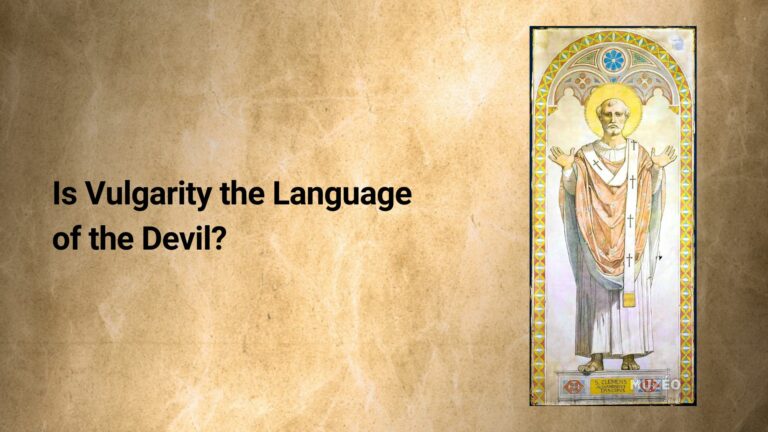
Christians Are Called to Something Higher. Saint Clement of Alexandria urged Christians to abstain from filthy speech and to discourage it in others. His warning reflects a fundamental Christian principle: our words should correspond to the dignity God has given us.
Rejecting vulgarity is therefore about much more than maintaining good manners. It is an exercise in self-mastery and an expression of love for God and neighbour. We were not created to drag ourselves and others downward through our words. We were created to seek what is true, good and beautiful.
If God has made man “a little less than the angels,” let us strive to speak accordingly.
Explore more reflections on the saints, Catholic devotion and the spiritual counsels of Padre Pio here at Following Padre Pio. https://www.youtube.com/channel/UC62YA49gU_tmOCfsqhHLx0w